
Wait, didn't we go through this already?
Building personal projects from my phone with AI feels a lot like open source did 26 years ago.

, 3 min read
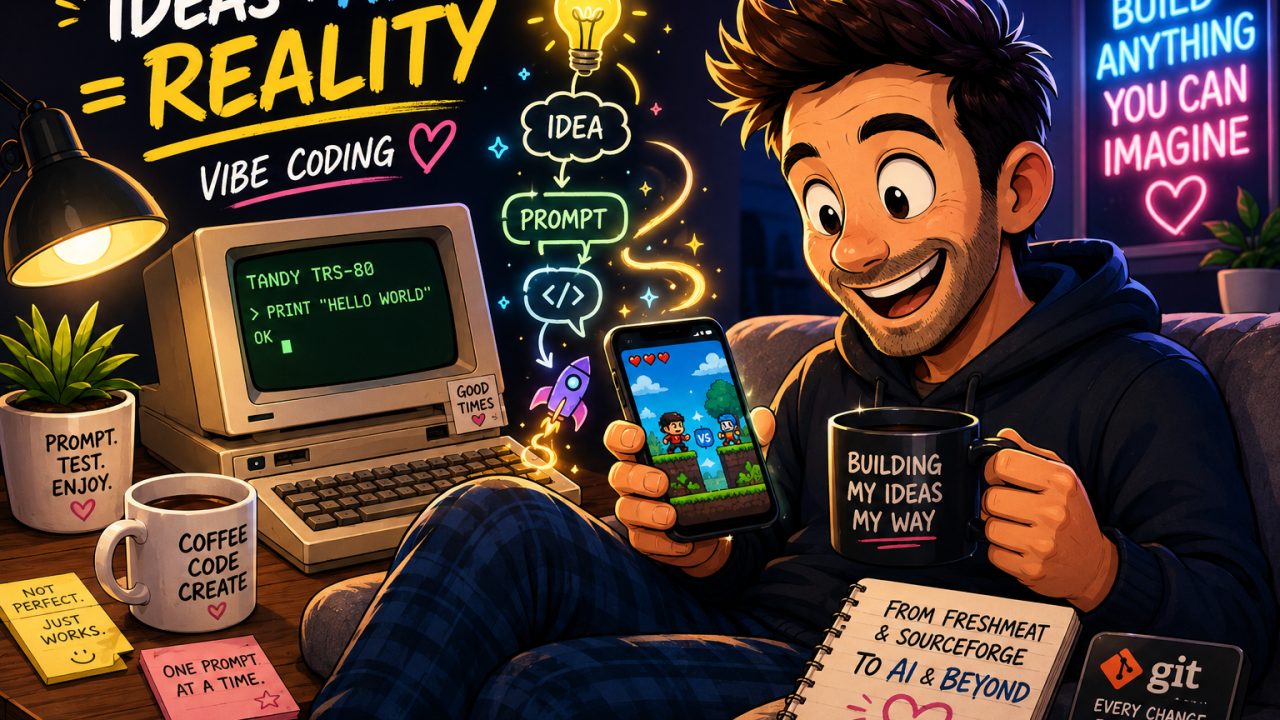
First published on LinkedIn on 18 June 2026. This copy is the one I keep up to date.
Still coding with a keyboard? Or already building from your phone?
Going full speed with orchestrating AI has not yet brought me the satisfaction of achieving results faster for a production environment, but it’s a hell of a lot of fun building personal projects, actual vibe coding, from my phone.
I purchased a subscription, so I’m making sure it’s being used.
Since having kids, my time spent playing video games came to a screeching halt. I still have games shrink-wrapped that I’ll get to, perhaps, but I don’t miss it.
When I have free time, I’m now playing with something else.
I don’t have to give it much attention, yet seeing the results of my creative imagination without sacrificing time for real life is really exciting.
I’ve built ideas into reality, and they work.
Never in one prompt, always steering it in the direction I want, in plain English, from the comfort of my phone.
It’s not working or looking right? That’s one prompt away to steer it.
I don’t care about the quality of the code. This is for personal projects. I haven’t even looked at the code. If I don’t have time for video games, I don’t have time to learn new programming languages AI has chosen that best fit my ideas.
I just prompt, test, and enjoy. Each change a prompt makes is documented in a git repository - that’s the software engineer in me.
My personal projects are unique, fitting exactly to my needs.
Wait, didn’t we go through this already?
With Open Source?
I was fortunate to have attracted interest worldwide from complete strangers, where one idea was shared that led to the building of an online community that fostered that idea further.
The goal wasn’t to have one solution that included the kitchen sink, but to have a foundation that could be worked on, to build it to your unique and fitting needs.
That was 26 years ago.
My prompt back then was not to an AI, but an announcement published to Freshmeat and SourceForge:
“Here is something you may be interested in. Where can we take it from here?”
I could do the exact same thing today - prompt an AI to build me the next killer e-commerce solution, and take over the world with it, this time knowing exactly what to do.
However, if I can do that, so can you.
Why bother now testing Open Source solutions to see which can better fit your needs, and not just prompt what you want to an AI model?
It delivers.
It’s now your choice to use code from a trusted Open Source solution and untrusted code from add-ons that nearly meet your needs, or use code generated by AI that exactly meets your needs.
Are you going to publish a question for support in an online community forum and pray for an answer, or prompt AI to fix it for you immediately?
Open Source solutions will need to shift, no longer providing solutions with the kitchen sink that try to cater to everyone, but focusing on a lean framework AI can build on, like a skill.
We not only attracted developers at the start, but also people who didn’t code.
Today, that’s vibe coding. The developers back then were the Human Intelligence agents, now there’s access to AI agents.
That allowed me to build something I never thought I would.
The last time I programmed a game was in my childhood on a Tandy TRS-80.
I am not a game developer. I’m not even a pro gamer!
But I vibe coded a game. A fun multiplayer game, in fact.
One of my personal projects, from the comfort of my phone.
And it works.