
"You are no longer software engineers"
We were told AI agents write the code now. What I keep is understanding it and answering for it.

, 5 min read
First published on LinkedIn on 7 June 2026. This copy is the one I keep up to date.
I came back fresh.
It’s amazing what three days of early Spanish summer sun can do, compared to the rainy weather we still have in Germany. My wife remarked how different I looked on my return, lighter in mood and with a hint of tan. Thanks to Waldemar Schwab, who guided us through the heart of Madrid, from the grand plazas towards Retiro Park. Beautiful city.
The heat, the drinks, the food, the city itself, the whole team together. We had gathered for something significant: no longer a technology team on its own, but part of a much larger organisation, opening doors and putting new opportunities within reach.
It was in that same meeting that the embrace of AI and the vision going forward came with a statement that has not left me since:
You are no longer software engineers.
The vision was clear. Writing the code would be handled by the agents. Our role was being redefined for us.
That is where the danger lives. AI is confident, and it wants to please you. It hands you something brilliant, something mediocre, and something confidently wrong with the exact same certainty, and you cannot tell which is which by glancing at it. You can only tell by understanding it. With most tools, working and being correct are the same thing. With this one, they are not.
The vision was not just talk. An example had already been built: a service scaffolded by AI. The stated confidence in the result was ninety percent. That confidence was not naive. There was real effort behind it, with tightly specified requirements. The code and structure looked sound, but the fundamentals and implementation patterns of the framework underneath were missing, revealing the limit of a perfect spec: it gives you exactly what you asked for, and none of what you did not know to ask for. The confidence was real. The understanding behind it was not.
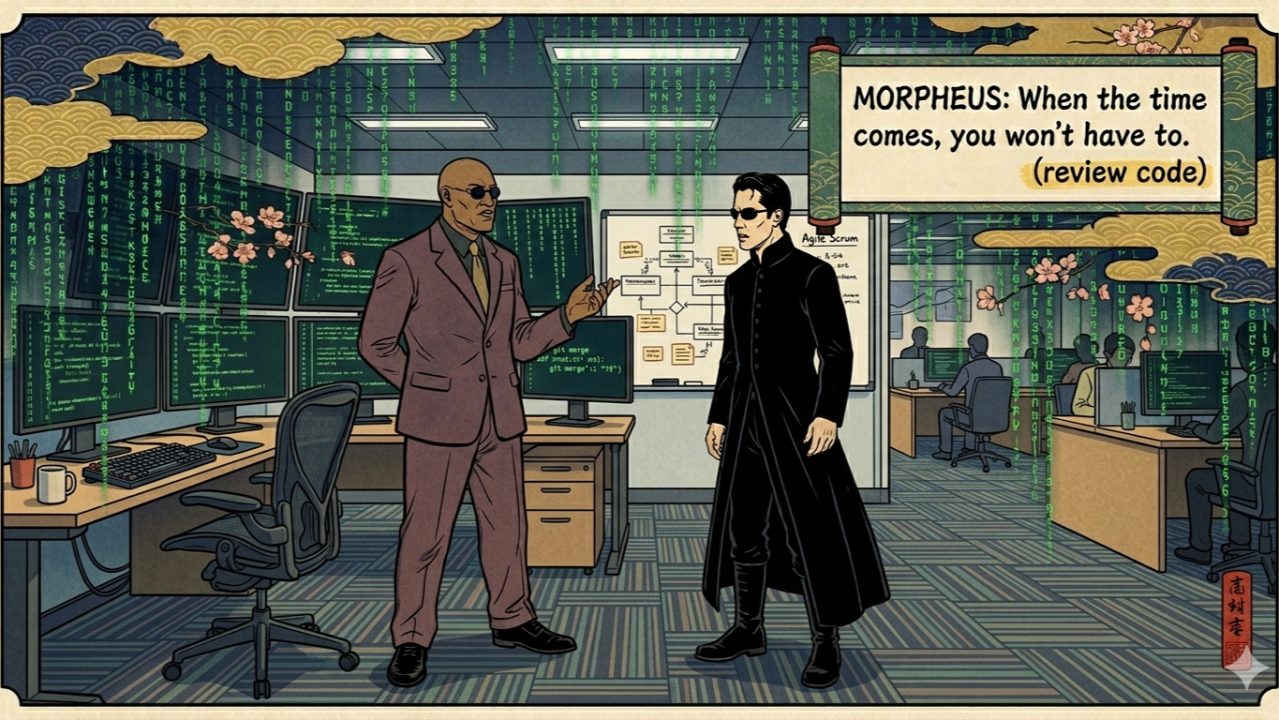
There is a trap worth avoiding here. A solution gets generated. It looks reasonable. A quick glance becomes a pull request, and you assume the reviewer will catch whatever is wrong. That is not just lazy. It is disrespectful. You are handing a colleague responsibility for code you never understood yourself. Review should never be the first time a change is examined critically. Before I open a PR, I should be able to say how the code works, why I chose it, what it trades off, and where it might fail. Until then, the PR stays in draft. What you tolerate in a weekend project does not meet the bar at work.
AI gets you there faster, and I am all for it. But the understanding remains mine. If you are working with AI and not learning from it, you are using it wrong.
The same applies on the other side. Let AI review your code, it catches plenty, and lean on it when you review a colleague’s. But a model checking another model is not a human who understood the change. If one model writes it and another approves it, no human did. And if you approve a change because the model said it was fine, neither did you.
This is no longer hypothetical. Some open source projects have banned AI-assisted contributions outright. The reasoning is blunt: those contributions carry negative value, worse than nothing, because they burn the limited review time of the people ultimately responsible for what gets merged.
As the creators of Vouch put it, AI lets people “trivially create plausible-looking but extremely low-quality contributions with little to no true understanding.” Once the barrier to producing a change collapses, you cannot trust a contribution simply because it was submitted.
I know how this sounds. Draw any line at all and you get labelled as someone who cannot adapt, protecting what they know because they are afraid of something radically different. That is not my argument. Those projects ban because they cannot vet a flood of contributions from strangers. A team can vet its own, so a ban is not the answer. I do not care whether a line was typed by a person, generated by a model, or some mix of the two. I care whether a human understood it before it was submitted for review, and whether a human will answer for it when it breaks. That has nothing to do with how the code was produced. It has everything to do with who is accountable for it.
So do not outsource your judgement, the one thing that makes you irreplaceable. Keep reading the code. Keep questioning it. Keep deciding not just how something should be built, but whether it should exist at all.
We were told we are no longer software engineers. If that means the typist, the one who only produced code, then good riddance. I am glad to hand the graft of heavy typing to the agents.
What I am keeping was always the point: understanding the work, steering it, making the decisions, and answering for it. That matters more now, not less. I am not mourning the old way. I cannot wait for the journey ahead.